Energy Security in South Africa

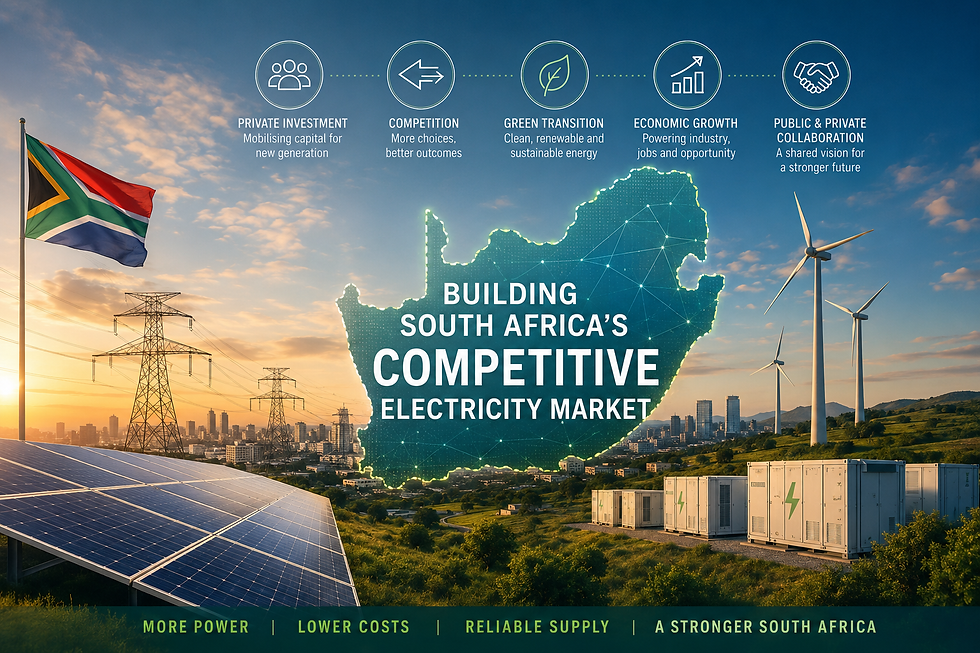
Building South Africa’s Competitive Electricity Market: From Crisis to Reform
South Africa’s energy sector is undergoing one of the most significant transformations in its democratic history. A recent discussion on Building South Africa’s Competitive Electricity Market brought together policymakers, Eskom representatives, traders, and private sector energy leaders to unpack how electricity reform is reshaping the country’s economic future.
The central message was clear: South Africa’s electricity crisis has created an urgent need for a more competitive, diversified and investment-friendly energy market.
For more than a decade, the country’s overreliance on a single vertically integrated utility exposed the economy to severe risk. Ageing coal infrastructure, constrained public finances and persistent load shedding highlighted the limitations of the old model. According to the presentations, hundreds of billions of rand in new generation investment will be required over the next decade, and government alone cannot finance this transition.
The reform agenda now focuses on opening the market to greater private sector participation while restructuring Eskom into separate generation, transmission and distribution entities. The creation of the National Transmission Company of South Africa (NTCSA) is viewed as a foundational step toward a transparent and competitive electricity market.
A major theme throughout the discussion was the shift from a single-buyer electricity system toward a “multi-market” model. Under this framework, electricity can increasingly be traded through bilateral agreements, wheeling arrangements and centralised market platforms. This transition is already accelerating private investment.
Energy traders and aggregators such as EXSA and NOA explained how market liberalisation is enabling renewable energy developers, industrial users and municipalities to access more flexible energy solutions. Since the removal of licensing thresholds, private generation projects have surged, with over 18GW of generation capacity registered outside the traditional REIPPPP programme.
The rise of energy traders is becoming a defining feature of the new market. Rather than relying on a single power purchase agreement between one generator and one customer, traders aggregate multiple buyers and sellers, reducing risk and unlocking finance for new renewable energy projects. Speakers argued that this model improves price transparency, lowers financing costs and creates a more resilient electricity ecosystem.
Another critical discussion focused on the green transition. Eskom Green outlined how the utility plans to position itself within a liberalised market by accelerating renewable energy projects, battery storage and flexible generation technologies. The transition is not only about decarbonisation, but also about decentralising electricity generation and enabling more participation from independent power producers (IPPs).
Municipal reform also emerged as an important frontier. While leading metros are already procuring renewable power and participating in wheeling arrangements, many municipalities remain financially distressed and operationally constrained. Panellists stressed that electricity distribution reform cannot follow a one-size-fits-all approach and must balance sustainability, affordability and municipal revenue protection.
Importantly, the discussion framed electricity reform not simply as an energy issue, but as a national economic imperative. Reliable, affordable and greener electricity is increasingly seen as essential for industrial competitiveness, investment attraction and long-term growth.
South Africa’s electricity market is clearly entering a new era , one defined by competition, decentralisation and collaboration between the public and private sectors. While challenges around grid access, regulation and implementation remain, the momentum toward reform appears irreversible. The success of this transition could determine not only the future of the energy sector, but also the country’s broader economic trajectory.


Impressive ,straight to the point we need a change we need leaders that know what theyre talking about